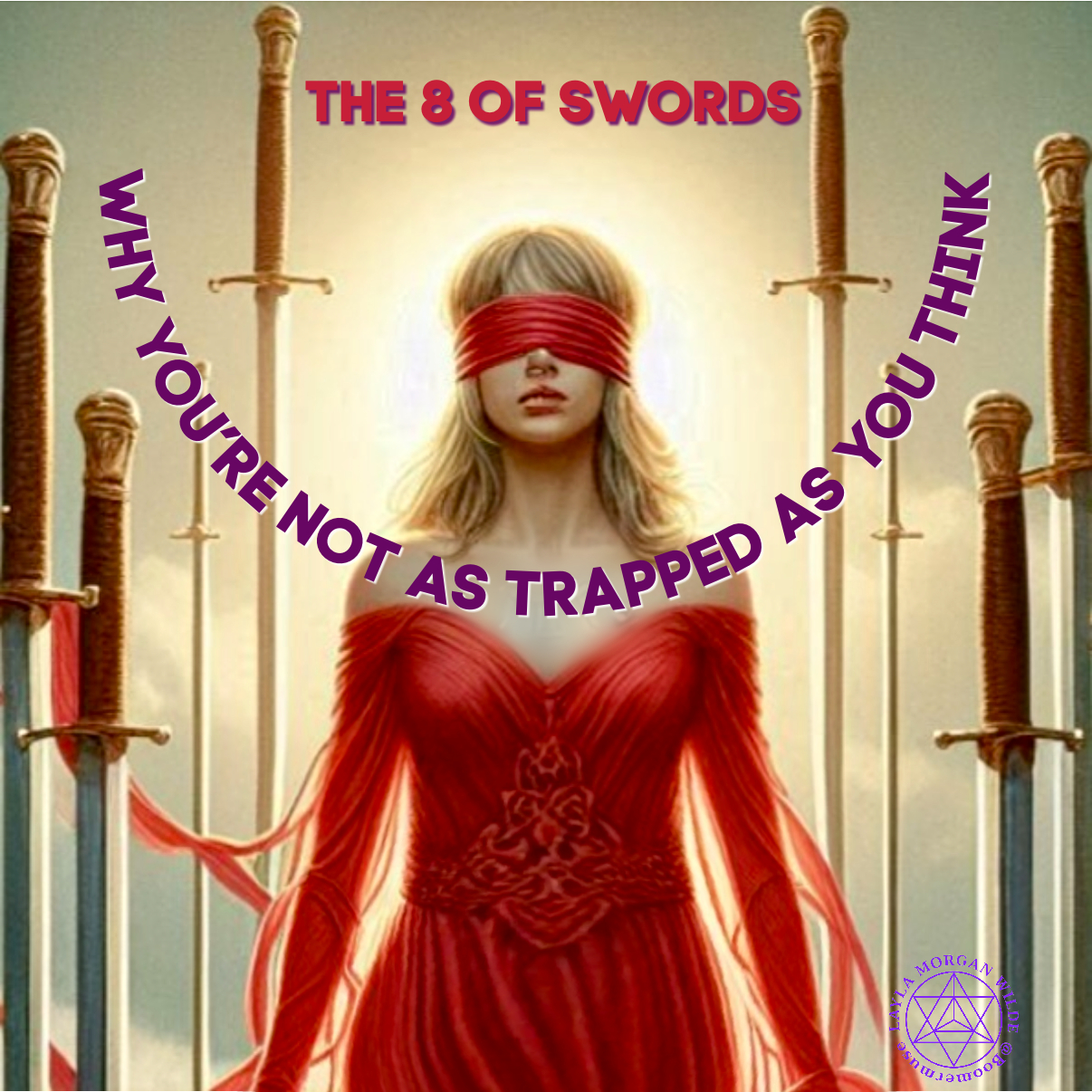
Today we do a deep dive into its tarot meaning, upright and reversed, plus the forgotten woman who drew her and why this card is far more personal than most readers realize.
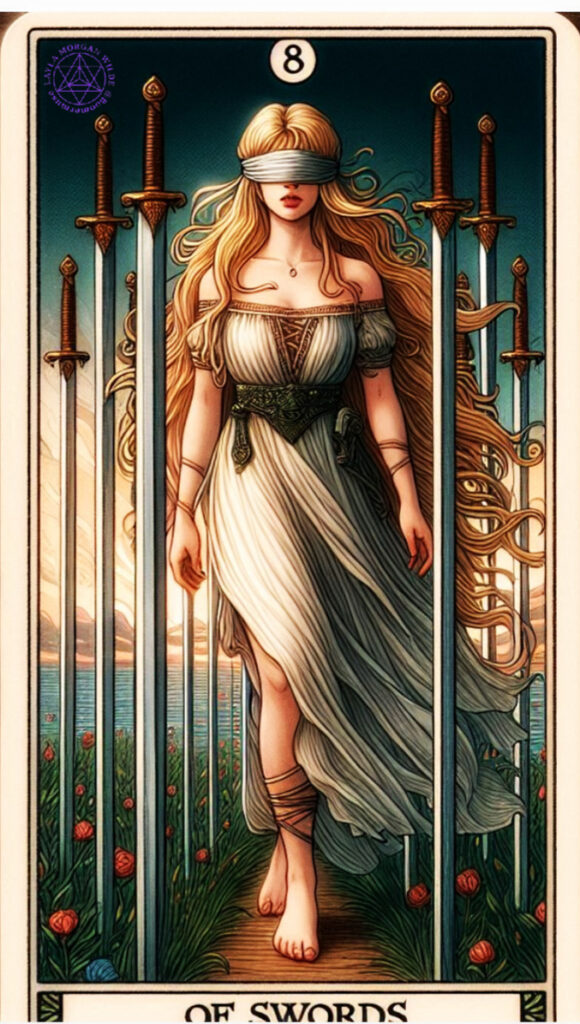
A Five Decade Love Affair
I received my first tarot deck when I was 18 years old and I have never looked back. Five decades and dozens of decks later, with more readings behind me than I could ever count, I like to think I have learned a thing or two.
Tarot has been a constant companion through every chapter of my life, the joyful ones, the devastating ones, and the long murky ones in between where you cannot quite tell what is happening yet. It has never once let me down as a mirror.
So when I recently went looking for my digital Eight of Swords artwork, pieces I had made and then not seen in a long time, I was not expecting to wade through quite so much. Or to feel quite so much wading through it. But that is tarot for you. It has a way of finding you exactly where you are.
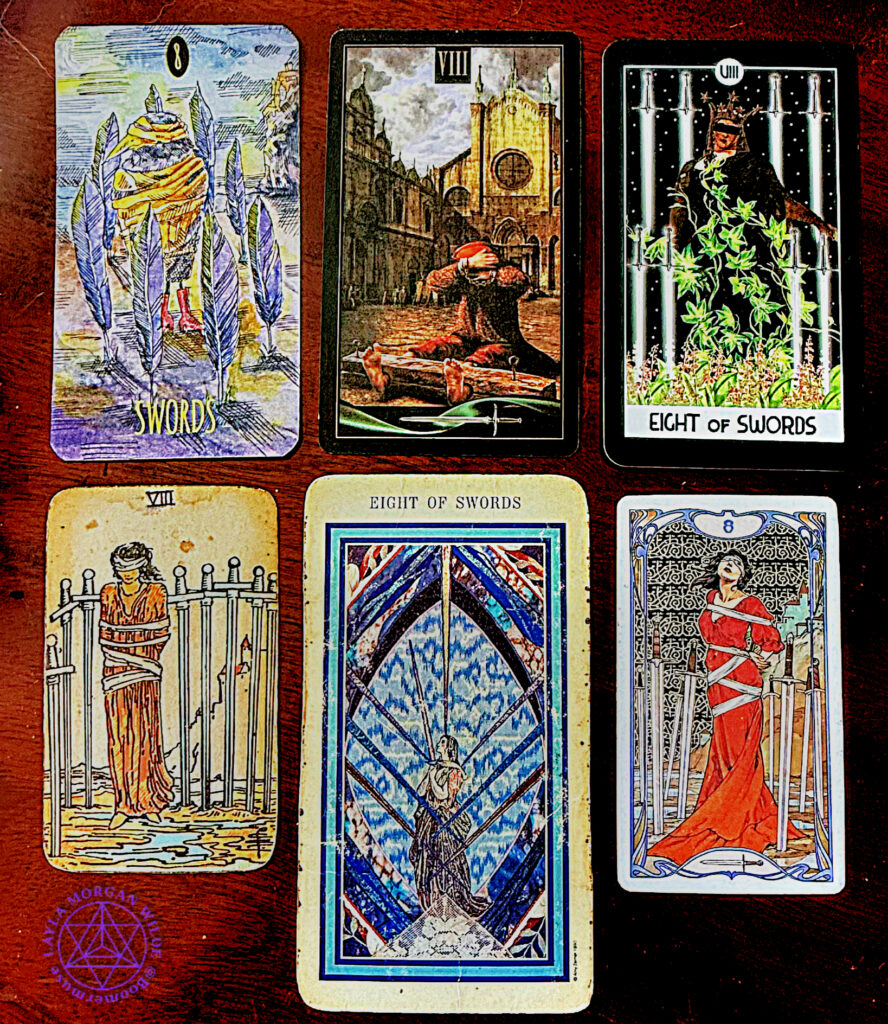
Before I began writing, I gathered a few eight of swords from six different decks took a photo which we can use here for reference today.
Why Is It Almost Always a Woman?
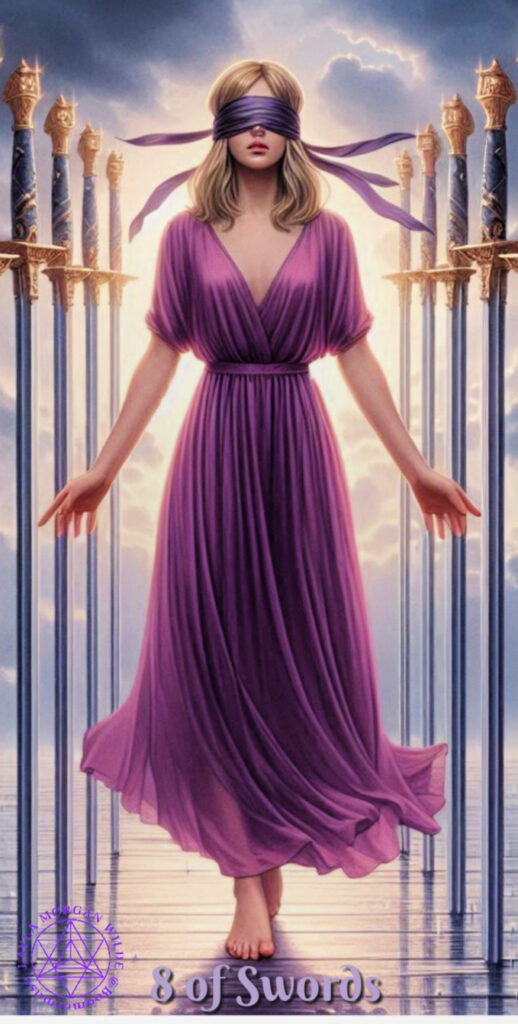
Before I get into the meanings, I have to share something that stopped me in my tracks when I looked into it. Across virtually every deck, the central figure in the Eight of Swords is a woman. The rate exception I have found is the Venetian deck, which is one I work with regularly. I started wondering why, and the answer turns out to be one of those beautiful historical ironies you could not make up.
The woman in this card exists because of Pamela Colman Smith. She was the artist who illustrated the original Rider Waite deck in 1909, and the Minor Arcana were hers entirely.
Before she came along, those cards showed nothing but symbols, eight swords arranged on a surface, nothing more. Smith was the one who turned them into living scenes with people and feeling and story. She drew this particular bound, blindfolded woman out of her own imagination and her own deep symbolic understanding.
And here is the part that got me. Smith received a small flat fee for her work. Her name did not appear anywhere on the original deck. The deck was named after the publisher and after Waite. She was essentially invisible. A woman who painted one of the most iconic images of a blindfolded, bound woman in the history of mystical art, and she herself went unseen for over a century.
Given how much I have been thinking about the divine feminine lately, that landed hard.
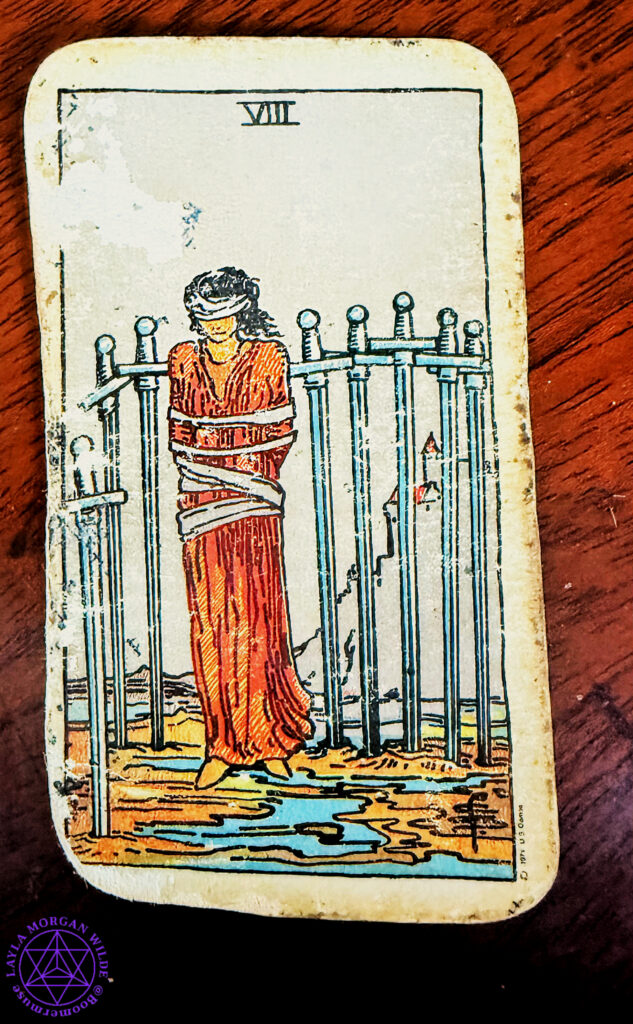
Look even more closely at the original Rider Waite image (lower left of the six) and two details reveal themselves that most people walk right past. Behind her in the distance there is a castle. It is not out of reach. It is simply behind her, solid and real and already built, representing the life that is waiting, the self she has temporarily lost access to. She does not need to construct anything. She just needs to turn around.
And at her feet there is water. In tarot water almost always speaks to intuition and the subconscious. That puddle is not incidental. It means her inner knowing is literally right there, present and available, even while her eyes are covered. She cannot see her way forward but some part of her already knows it. Her body is standing in the answer while her mind insists she is trapped.
As someone who ventures barefoot into the garden daily in all four seasons, I love that most decks show her barefoot, grounded, no separation between her and her Earthy power.
The castle says the destination is real and already there. The water says the wisdom to find it never left. The only thing standing between her and both of those things is the blindfold.
The Figure in the Middle
Almost universally, she appears surrounded by swords that look, at first glance, like a cage. And I get it. I have felt that feeling. The sense that every direction is blocked, that the timing is wrong, that you should wait.
But look closely at almost any version of this card and you will see it. There is space. Behind the swords, in front of them, between them. The blockage is real in the sense that it feels real. But it is not actually a sealed room. It is the illusion of being trapped. And the only thing holding her there is the blindfold.
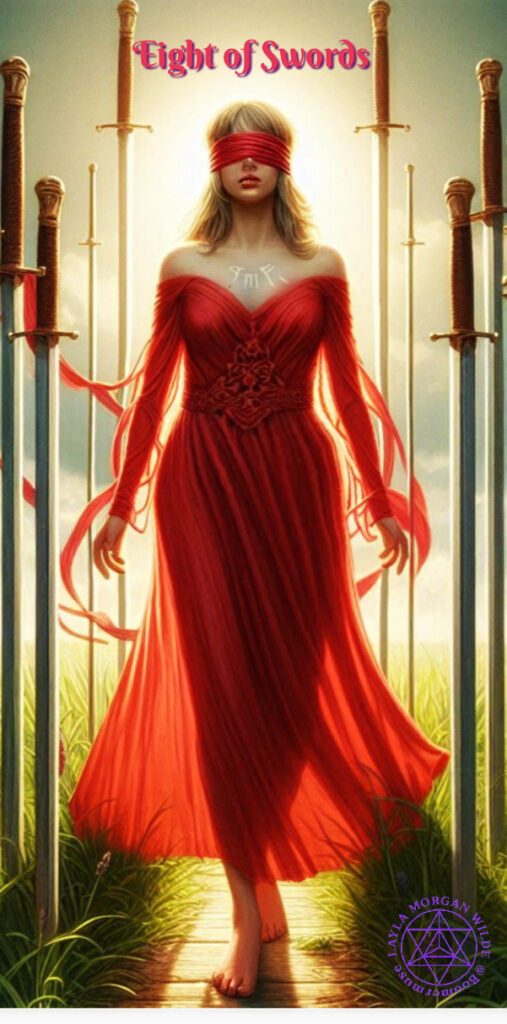
Upright: The Paralysis That Lives in Your Head
In its upright position, the Eight of Swords is about the particular kind of stuck that is entirely internal. Overthinking. Self-censorship. The voice that says not yet, not you, not now. There can be a sense of delay, of waiting for something outside yourself to change before you feel free to move.
The card gently but persistently insists that at least part of the powerlessness is a story you are telling yourself. The blindfold matters here. You cannot see your own way out because you are not looking.
Reversed: The Blindfold Comes Off
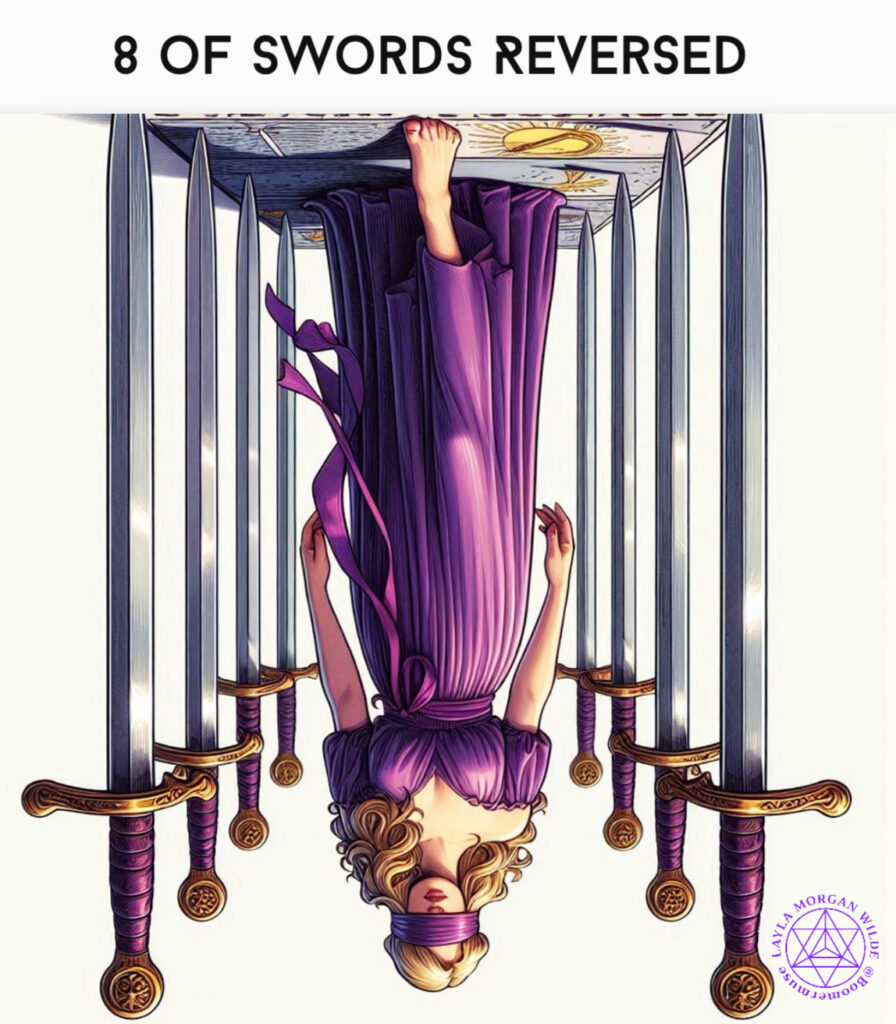
When this card reverses, something shifts. It can signal genuine release, finally seeing clearly, finally stepping out of the mental cage you have been pacing in. But it can also mean the self-limiting beliefs have gone underground and gotten quieter and sneakier. A reversed Eight of Swords sometimes means the inner critic has not left. It has just gotten more subtle. Worth paying attention to which version is showing up for you.
Here is an image that came to me when I flipped one of my own cards upside down. Think about shaking a box of cereal. Nothing dramatic, no great effort required. You just turn it over and gravity does the rest. Things that were wedged in there simply fall out because that is what things do when you finally invert the container they have been sitting in. The reversal of this card can feel exactly like that. Not a struggle. Just a quiet shift in orientation and suddenly what was stuck is moving on its own.
The Kneeling Woman
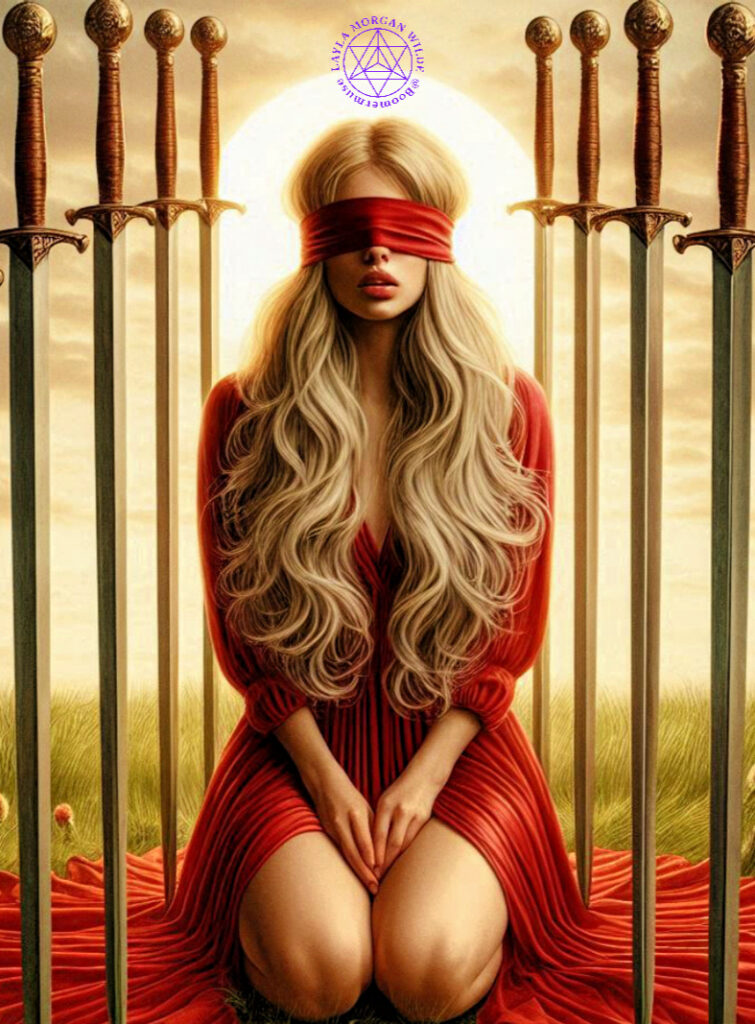
In one of my own pieces from this series, the figure is not standing. She is kneeling, the hem of her long dress gathered in a full circle around her within the ring of swords. It stopped me when I found it again after all this time. Because she is not trapped and she is not fleeing.
She is in a third position that most readings of this card never mention. Sacred surrender. The deliberate pause before the first step but not as intense as The Hanged Man. Sometimes that is exactly what is needed, not more striving, not pushing through, but a moment of going all the way down before you rise.
This Is Personal
I look at that bound figure and I recognize her. For most of the past year, honestly longer than that, I thought I was stuck. I was not writing here. I was not moving in the ways I expected myself to move, and I kept measuring myself against some imagined version of progress that looked busy and visible and constant.
What I understand now is that I was gestating. The next phase of my life was forming in the dark, the way things always do when they are becoming real. The way butterflies gestate in a cocoon of goo, blind to their future beauty, life and purpose.
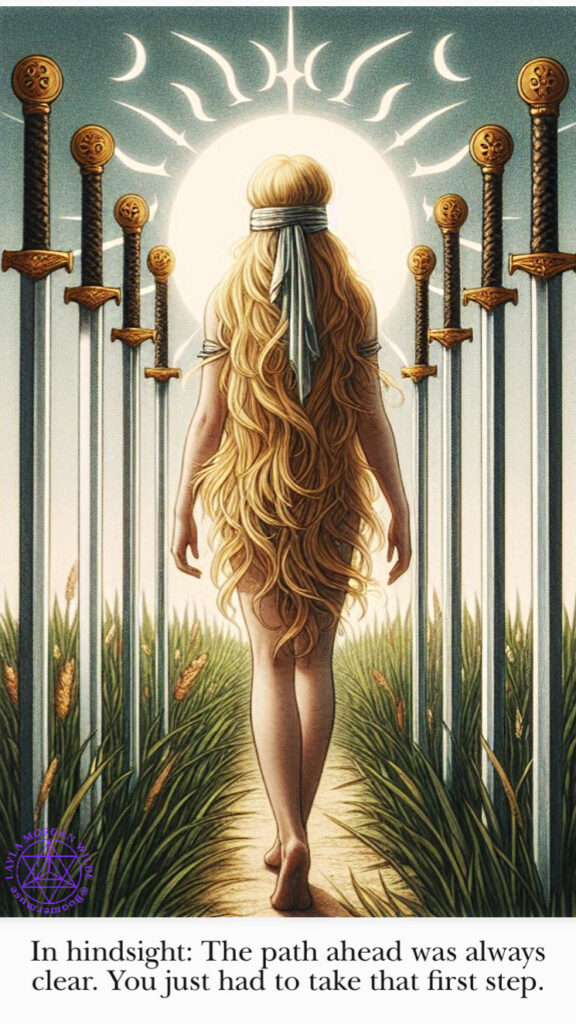
Progress when you are in the middle of it is often invisible. Incremental does not feel like movement. But look back six months, a year, and suddenly the distance is undeniable.
The Eight of Swords does not judge the woman in the middle. It just keeps quietly pointing out that the path is there. The swords are not the walls. Take the step.
Ready?
